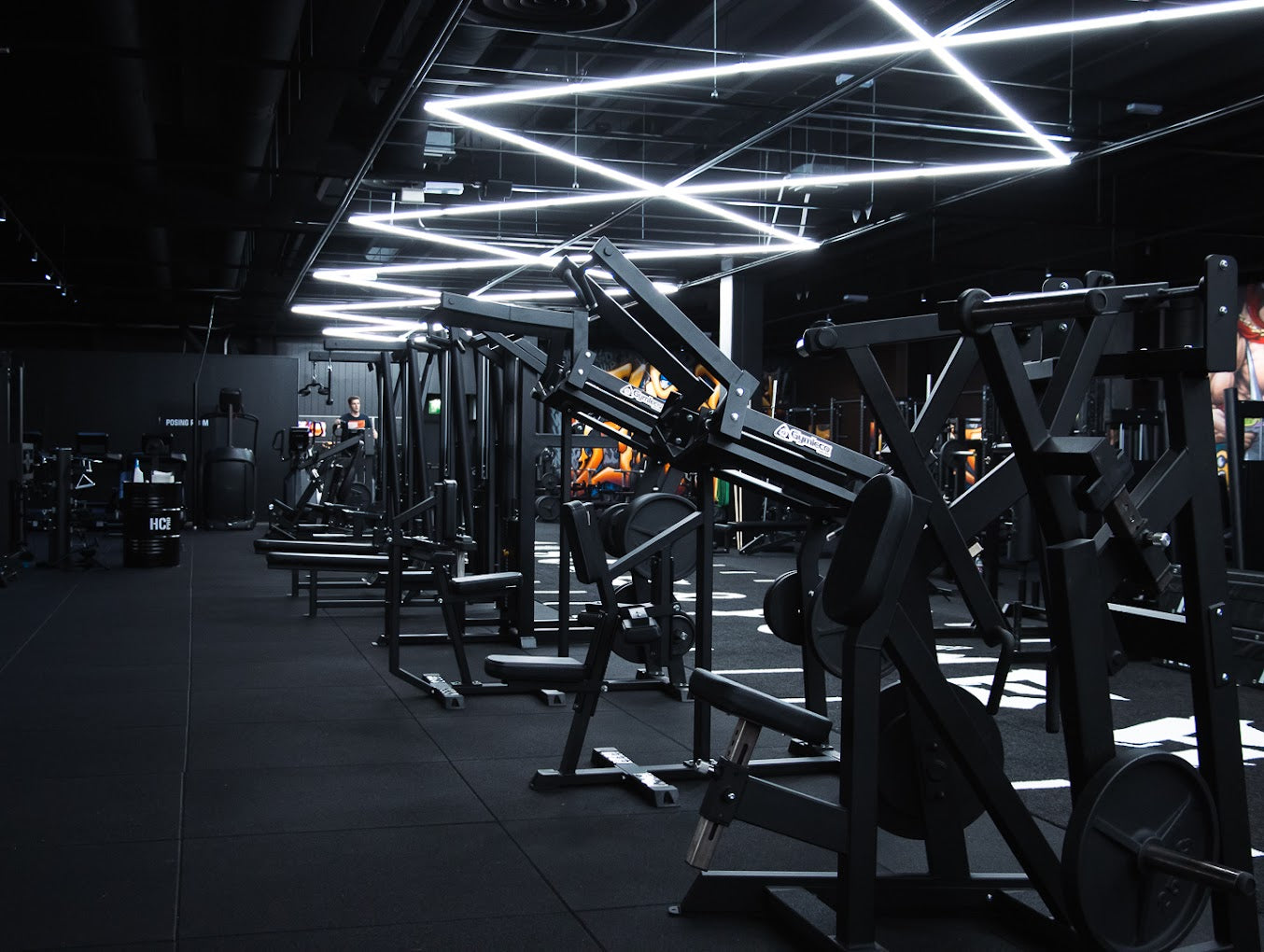
Lighting does two jobs in a gym: it keeps the room safe, and it makes the place somewhere people want to walk into. Both are measurable. Here are the numbers.
How much light does a gym need?
300 lux is enough for the training floor. In the free-weights area, where safety decides, aim for 500 lux. In a studio or yoga room 150–200 lux is plenty – there, dimming matters more than brightness.
How many cells for your space?
| Room size | Cells | Power | Electricity / year* |
|---|---|---|---|
| 50 m² | 7 | 168 W | ~€63 |
| 80 m² | 11 | 264 W | ~€99 |
| 120 m² | 17 | 408 W | ~€153 |
| 200 m² | 28 | 672 W | ~€252 |
* 2,500 hours a year at €0.15/kWh. A large hall is worth splitting into several separate fixtures – it is also easier to install that way.
Zones matter more than wattage
The same hall needs different light at different times: full brightness for the morning session, half in the evening, a low level for cleaning and filming. One Q1 remote controls four zones, so free weights, machines, the studio and reception can run independently of each other.
A practical tip: do not buy a separate dimmer for every fixture. Count the zones across the whole order – usually one remote is all you need.
RGB or white?
White 6500 K is the only sensible choice for the training floor. It keeps the room bright and safe.
RGB works as an accent: along a wall, at reception, in the studio. An RGB tube draws only 1.8 W, so a large RGB installation is cheap to run. Do not try to light the gym itself with RGB, though – it will not do the job.
High ceilings
If the ceiling is above 3.5 m, light spreads on the way down and less reaches the floor than the table promises. Suspend the fixture on wires at 2.5–3 m – that is cheaper than adding cells. Wires come in 1, 2 and 3 metre lengths.
Design your own
Enter your dimensions and see the parts, power, illuminance and price straight away: Hexagon configurator. You can plan each area separately within the same order.
Ready-made solutions: Gym lighting.